December 02, 2025
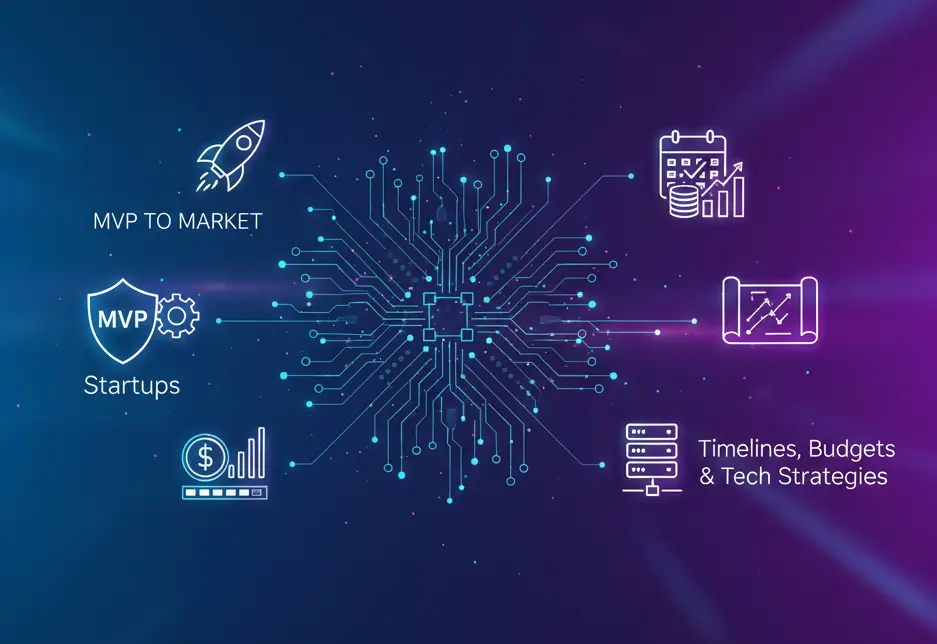
Building an MVP in 2025 is no longer just about releasing a basic version of your product. Today’s market moves quickly, and startups must balance speed, quality, and cost while keeping investors and early adopters engaged. The most successful startups treat MVP development as a strategic process—one that blends lean product development, market research, smart budgeting, and scalable technology. In this guide, we break down the real timelines, realistic budgets, and proven tech strategies that startups must follow to go from MVP to market in 2025.
What MVP Development Really Means in 2025
In 2025, building an MVP means launching a simplified yet high-performing version of your idea that validates your assumptions with real users. Unlike older approaches, MVPs today require a more thoughtful balance between functionality, user experience, and scalability. Users expect polished interfaces, fast performance, and AI-driven personalization—even in early-stage products. Startups that focus solely on minimal features often struggle to gain traction. Instead, the modern MVP must demonstrate value, provide a smooth onboarding experience, and offer enough functionality to test your core hypothesis.
- How MVPs Have Evolved in the Last Five Years
Between 2020 and 2025, the startup landscape shifted dramatically. Users became more demanding, competition increased, and AI automation raised expectations of speed and personalization. As a result, MVPs can no longer be prototypes—they must be functional, stable, and appealing. An MVP must deliver immediate value and demonstrate potential for scalability. This evolution has pushed founders to use agile methodologies, rapid prototyping, and cloud-based infrastructure to accelerate development.
Real-World MVP Timelines in 2025
Every founder asks: “How long does it really take to build an MVP?” The truth is, timelines vary based on the complexity, required integrations, team experience, and readiness of the startup’s requirements. In 2025, the average MVP development timeline ranges between 6 and 16 weeks. AI tools, improved frameworks, and component libraries have reduced development time, but planning, UX design, and testing still require human expertise.
- Standard MVP Timeline Breakdown (2025)
A realistic MVP development timeline for 2025 looks like this: Week 1–2: Research, planning, technical architecture, user flow mapping; Week 3–5: UI/UX design, building core screens, prototyping; Week 6–10: Backend development, API integration, mobile/web development; Week 11–14: QA testing, improvements, performance optimization; Week 15–16: Deployment, analytics setup, beta launch. Using AI-assisted development and pre-built component libraries can shorten these timelines by 20–30%.
- Factors That Speed Up MVP Development
Clear requirements, fewer features, reusing components, cloud-based infrastructure, selecting the right tech stack, and working with an experienced development team significantly reduce development time. AI-powered tools also help with code generation, UI layout suggestions, and automated testing.
Realistic MVP Costs and Budgeting in 2025
One of the biggest concerns for founders is cost. In 2025, MVP budgets vary widely based on scope, features, region, tech stack, and the development team’s expertise. While AI-assisted development helps reduce manual work, complex features such as AI recommendations, real-time chat, and custom dashboards still require significant engineering effort. A proper budget ensures your team can deliver a stable, scalable MVP without cutting corners.
- How Much Does an MVP Cost in 2025?
In 2025, the average MVP cost ranges between $15,000 and $80,000, depending on complexity. Simple MVPs like marketplaces or basic SaaS tools cost between $15,000 and $35,000. Medium-complexity MVPs such as social platforms, fitness apps, or booking apps cost between $30,000 and $55,000. AI-driven, real-time, or highly custom MVPs can reach $60,000 to $80,000 or more. Choosing the right features and avoiding “nice-to-haves” helps keep costs under control.
- How to Budget Efficiently as a Startup Founder
Founders should allocate their budget across five core areas: Design (15%), Backend development (35%), Frontend development (35%), QA/testing (10%), Deployment & maintenance (5%). This balanced distribution ensures that critical areas such as performance, user experience, and security are adequately covered.
Top Tech Stacks for Building MVPs in 2025
Selecting the right tech stack is one of the most important decisions during MVP development. In 2025, the trend is clear: choose technology that accelerates development, allows easy iteration, and scales with user growth. Modern frameworks like Flutter, React Native, Next.js, and Node.js dominate the MVP world because they enable fast development, reusable components, and cross-platform deployment.
- Recommended Frontend and Mobile Frameworks
For mobile apps, Flutter and React Native offer fast, cost-effective development with excellent UI performance. For web apps, Next.js and React remain the top choices due to their SEO capabilities, performance, and rich ecosystem. These frameworks allow quick iteration and smooth scalability.
- Best Back-End Technologies for 2025 MVPs
Node.js, Django, Laravel, and serverless cloud functions (AWS Lambda, Firebase) are the leading back-end technologies for 2025 MVPs. They provide secure, flexible, and scalable environments that enable rapid development without heavy infrastructure costs.
How to Successfully Launch Your MVP in 2025
Launching an MVP is more than pressing a deployment button. Founders must prepare marketing assets, analytics dashboards, onboarding experiences, user feedback loops, and scalable hosting. A strong launch strategy includes collecting data, improving the product based on insights, and preparing for future updates. With the right approach, your MVP becomes a stepping stone to full product-market fit.
- The Startup Launch Checklist (2025 Edition)
Ensure your MVP launch is successful by following these steps: Set up analytics (Mixpanel, GA4), create a clear onboarding flow, prepare a landing page, run pre-launch campaigns, collect user feedback, track feature usage, and quickly address bottlenecks. Early traction depends on user activation and feedback.
- Post-MVP Roadmap: Iteration, Feedback, and Scaling
After launching the MVP, focus on learning. Review user feedback, prioritize high-impact improvements, optimize UX, enhance performance, introduce missing features, and test your value proposition. Once early metrics improve, you can scale your product, raise funding, and strengthen your tech infrastructure.
Did you find this article useful? Sharing it with your network can help others discover the valuable insights you’ve learned! Whether it's through Facebook, Twitter, or LinkedIn, sharing this content is a great way to contribute to a larger conversation. Let’s empower others together!